

The first is managerial authority: the legitimate right to make decisions, allocate resources, coordinate effort, and bear accountability for outcomes. This authority is assigned by the organization. It flows from position, contract, and hierarchy. It exists because someone has to decide, and deciding requires a decider.
The second is knowledge authority: the capacity to make a well-informed judgement about a specific question, grounded in evidence, expertise, or proximity to the relevant context. It is situational, not positional. Its credibility depends on the quality of the inquiry, not the title of the person presenting it.
These two forms of authority sometimes reside in the same person. Often, they do not. The mistake is treating the first as if it automatically conferred the second.
Authority Decides; Knowledge Informs
When a manager says “I decide,” that’s a statement about jurisdiction. When the organization hears “I’m right,” that’s a category error.
To be clear, managers are not ignorant by default. They possess a different and legitimate kind of knowledge — enterprise constraints, budget realities, legal exposure, strategic tradeoffs, timing pressures, stakeholder politics. This knowledge is real and necessary for good decisions. The problem begins when the organization treats it as if it subsumed every other kind.
The distinction is between two questions. Who has the right to decide, and who has the best evidence for a specific claim?

Why the Two Diverge
Knowledge is Dispersed
Friedrich Hayek’s 1945 essay “The Use of Knowledge in Society” starts from a problem that should be familiar to anyone who has worked inside a complex organization: the knowledge needed to act is scattered across people, places, and circumstances. Some of it is technical. Some is local and practical — what has changed, what’s available, what keeps failing, what a particular situation requires.
Hayek was writing about economic coordination. Applied to organizations, his argument helps explain why a reporting chain can’t simply be assumed to contain everything the people doing the work know. A customer complaint, a recurring system failure, or a workaround on the factory floor may lose its significance when reduced to a metric or summary.
This doesn’t make direct experience infallible. It makes it a source of evidence that central decision-makers can’t safely replace with their own distance from the problem.
Expertise is Specific to the Question
John Hardwig’s work on epistemic dependence explains why we sometimes have good reasons to rely on another person’s judgement even when we can’t independently assess all their evidence. That reliance needs a basis: relevant competence and reasons to trust the person’s inquiry.
A manager’s expertise in financial modelling doesn’t automatically establish expertise in software architecture, user experience, or supply-chain logistics. Experience can transfer useful ways of thinking across domains. It doesn’t remove the need to demonstrate competence in the question actually being decided.
The same standard applies to specialists. A designer’s understanding of a usability problem does not, by itself, settle whether the organization can afford a particular solution. Different people can know different parts of the same decision.
Information Changes as it Moves Upward
A senior manager may receive a recommendation after several people have selected, interpreted, and summarized the evidence. Each layer can improve it by checking assumptions and connecting it to wider constraints. Each can also remove something important.
Reitzig and Maciejovsky’s research on corporate hierarchy and vertical information flow examines how evaluation apprehension and a perceived lack of control can reduce the willingness to pass ideas upward. Their experiments found a stronger effect for costs associated with lack of control than for evaluation apprehension. The findings are context-dependent, but give reason to question whether reporting structures leave information flow unaffected. Study, pp. 1993–1995.
I call the loss of uncertainty, dissent, attribution, and context as information is simplified and passed through an organization organizational compression.
Compression is necessary. A director can’t read every single interview transcript or inspect every line of code. The question is what the shorter version preserves. A finding can become a recommendation, then an executive conclusion, while the conditions that made it valid… disappear.
A manager can end up making a reasonable decision about an unreasonable representation of the evidence.
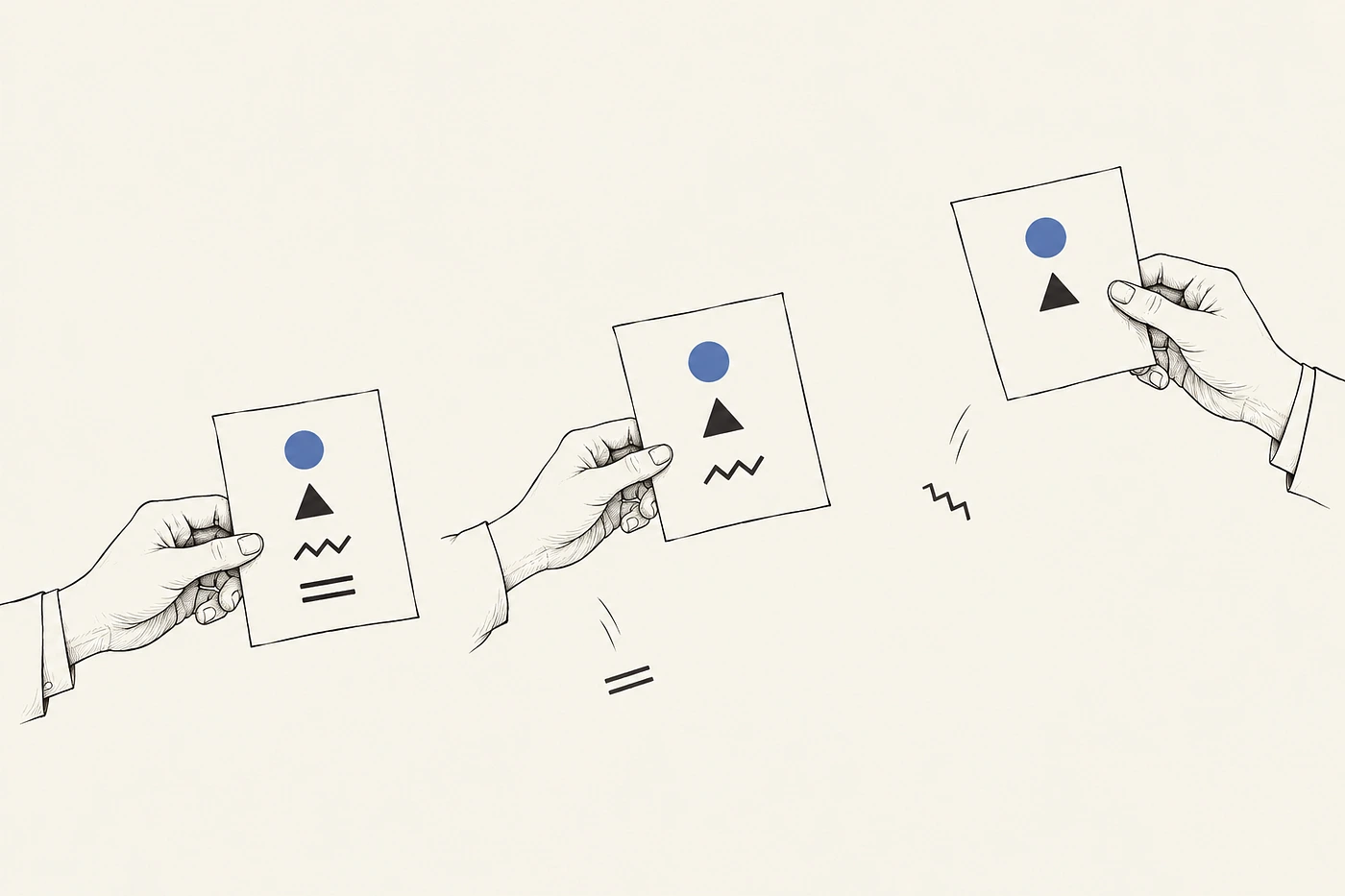
Promotion can widen this gap. Greater responsibility may mean less direct contact with the work and more reliance on other people’s accounts. That’s a risk to manage, not a universal rule that seniority and knowledge move in opposite directions. Strategic breadth is valuable. It simply cannot stand in for current operational detail.
Why Organizations Conflate Them
Rank Becomes a Shortcut for Competence
Assessing evidence takes time. Titles, confidence, seniority, and past success offer a faster answer to the question of whom to trust. Sometimes, these signals point toward relevant expertise. Sometimes, they only point toward influence.
In Anderson and Kilduff’s 2009 study of small groups solving math problems, participants higher in trait dominance were perceived as more competent and attained greater influence, although their answers were no more likely to be correct. This illustrates how perceived competence and measured performance can diverge in a particular group setting. Original study, pp. 497–500.
The workplace version is familiar. Once the most senior person has stated a view, disagreeing can carry consequences that agreeing does not. A specialist may soften a finding, frame it around the preferred conclusion, or decide the effort of challenging it is no longer worth the cost.
The resulting silence can then be mistaken for agreement. Rank has helped shape the apparent evidence for its own correctness.
Accountability Becomes Presumed Expertise
Managers bear accountability for budgets, timelines, compliance, and outcomes. That accountability is legitimate. But “the manager is responsible for the decision” can quietly become “the manager is best positioned to judge every claim beneath it.”
Accountability for consequences is not the same as proximity to evidence.
I call this authority inflation: legitimate authority in one domain expands into presumed authority in another without corresponding expertise or evidence. Owning the budget becomes approving the design; approving the design becomes defining whether the usability evidence is valid.
A manager may reasonably decide that a documented usability problem cannot be addressed this quarter. That is a decision about priorities. Saying the problem doesn’t exist because the manager has decided against addressing it is a different claim, and it needs different evidence.
The historical separation of planning from execution offers one useful precedent. In “The Principles of Scientific Management,” Taylor assigned management a larger role in developing methods and preparing work previously left to workers. He also emphasized cooperation and shared responsibility. His writing supports a narrower point about allocation of knowledge and planning; it doesn’t establish that all contemporary command-and-control cultures descend directly from Taylorism.
The relevant question today is whether the people controlling the plan remain answerable to what the people doing the work discover.
Control of the Channel Becomes Ownership of the Knowledge
A manager may control which findings are funded, escalated, presented, or recorded. That power extends beyond choosing an action. It influences which account becomes the organization’s account.
Consider a hypothetical sequence:
A researcher identifies a problem; a designer develops a response; a manager approves the recommendation; a director presents it. The final record says “leadership recognized the need.” The original inquiry has disappeared from the story.

I call this provenance capture: knowledge produced by one person or layer becomes attributed to whoever controls its interpretation, approval, or representation.
Nothing has to be deliberately stolen. Routine summaries and approvals can produce the shift. Being accountable for a decision becomes being credited with making it, then originating its reasoning, then understanding the issue best.
Authority inflation concerns the expansion of presumed competence. Organizational compression concerns what is lost in transmission. Provenance capture concerns the reassignment of apparent origin. They can reinforce one another, but they are not the same process. These are concepts I’m developing through Chain of Ownership, not established empirical categories that the cited research has already validated.
What it Costs
The consequences range from avoidable product mistakes to failures with catastrophic human costs. These cases illustrate different ways evidence and authority can become misaligned. They do not establish one explanation for every institutional failure.
The Challenger Disaster
Before Challenger’s launch in January 1986, Morton Thiokol engineers raised concerns about the effect of low temperature on the booster joint seals and recommended against launching under the anticipated conditions. The Rogers Commission found that Thiokol management reversed its recommendation at NASA Marshall’s urging, contrary to its engineers’ views, to accommodate a major customer.
The commission also identified communication failures, incomplete and sometimes misleading information, conflict between engineering data and management judgements, and a structure that allowed safety problems to bypass key managers. The accident killed all seven crew members.
This was a technical failure within an organizational failure. The evidence does not require a story in which every engineer knew the outcome in advance and every manager simply ignored certain knowledge. It establishes that serious engineering concerns weren’t adequately represented in the process that authorized launch.
The distinction matters. A decision process must be able to act on credible uncertainty about safety, not only on proof that failure will occur.
The Boeing 737 MAX
The U.S. House Transportation and Infrastructure Committee’s 2020 majority-staff investigation identified production pressures, faulty design and performance assumptions, withheld information, conflicts in delegated certification, and failures of FAA oversight. Its account included management failures and mistaken technical assumptions by engineers. The two crashes killed 346 people.
The committee also reported instances in which FAA management overruled technical experts at Boeing’s behest. These findings support an argument about how organizational pressures and authority can interfere with the evaluation and communication of safety evidence.
They do not support reducing the entire failure to knowledgeable engineers being overruled by non-technical managers. Expertise itself must be tested, and the institutions responsible for testing it must be able to challenge assumptions without commercial priorities determining what counts as an acceptable answer.
The Post Office Horizon Scandal
Horizon presents another version of the problem: an institution’s account of a system carried greater authority than the reports of people using it.
In the 2019 Horizon Issues judgement, the High Court found that bugs, errors, and defects could cause apparent discrepancies or shortfalls in branch accounts. The judgement also criticized the Post Office’s resistance to acknowledging problems with Horizon. These findings undermined the assumption that a recorded shortfall could safely be treated as proof of wrongdoing by a sub-postmaster.
The consequences were not limited to poor internal decisions. In Hamilton and others v Post Office Ltd, the Court of Appeal quashed convictions and found failures of investigation and disclosure that made prosecutions an abuse of process. Link to the full judgment, paragraphs 120–138 and 447.
Sub-postmasters’ reports did not, by themselves, establish the technical cause of every discrepancy. They were evidence requiring investigation. The institutional assertion that the system was reliable could not legitimately settle those questions in advance.
The Quieter Costs
Most organizations will not face a Challenger or Horizon. They can still lose access to knowledge they have paid to acquire.
Amy Edmondson’s study of 51 work teams in a manufacturing company found an association between psychological safety and learning behaviour. It supports the importance of conditions in which people can ask questions, report problems, and take interpersonal risks; it does not mean that safety alone guarantees sound decisions.
When raising a concern repeatedly produces dismissal or punishment, people may stop raising it. The decision-maker then receives a cleaner account of reality, while the organization interprets the absence of challenge as confidence in the plan.
The failure can happen with intelligent, experienced, self-aware managers. The system only needs to make their interpretation easier to advance than the evidence that complicates it.
Counter-Models
Deference to Expertise
High-reliability organizing offers a useful principle: expertise relevant to a developing threat may sit with the person closest to it rather than the person of highest status. AHRQ’s account of high-reliability principles describes deference to expertise alongside attention to failure, operations, and resilience. It also notes that implementation can be uneven.
The lesson is to build explicit ways for relevant expertise to influence action, including defined escalation and stop-work authority where appropriate. Decision rights can be allocated according to the situation, with clear limits and accountability, rather than assumed to belong permanently at the top.
Go & See
Toyota’s genchi genbutsu principle asks people to go to the location or process where a problem exists, confirm facts, and examine causes.
For a manager, that means closing the distance between a report and the conditions it describes. Observe the work. Talk to the people doing it. Test the summary against its source.
A visit is not a substitute for sustained expertise, and observation does not remove the need for interpretation. It does make managerial understanding more answerable to the work itself.
The Better Norm
The managerial job is to design a process where the right knowledge can reach the decision. Several practical changes follow.
- Separate who decides from who supplies the evidence. Record the decision owner, the relevant specialists, and the basis for their claims. One person may fill several roles, but the roles remain distinct.
- Preserve what compression would otherwise remove. Keep the recommendation concise, while linking to its evidence, limits, unresolved disagreements, and contributors. Make the fuller account accessible.
- Give challenge a usable route. Define how evidence can be questioned or escalated, especially when the decision owner is also the person whose interpretation is being challenged. An invitation to speak means little if speaking carries an unmanaged penalty.
- Locate decision rights deliberately. Delegate decisions that depend on local or time-sensitive knowledge when the team has the competence, resources, and authority to act. Keep cross-functional constraints visible and specify when escalation is required.
- Make overrides explainable. A manager may reject a specialist’s recommendation because of cost, timing, competing evidence, or accepted risk. Record that reason without rewriting the original finding or erasing who raised the concern.
- Check the source. When a decision depends on a process, customer, or system, examine the underlying evidence and speak with the people closest to it. A polished summary is a representation, not the whole situation.
These changes preserve coordination while making the decision process open to scrutiny. They also preserve a distinction that outcome-based credit often erases: a successful result does not prove that every assumption was sound, just as a failed result does not prove that every contributor’s judgment was wrong.
Chain of Ownership
This is the starting question for Chain of Ownership: what happens to knowledge as it moves through authority?
Who can define the problem, alter the recommendation, approve the response, suppress a concern, or represent the reasoning afterward? How do those powers change as work moves from inquiry to decision to institutional story?
Chain of Authorship asks how an understanding, decision, or artifact came into being and evolved. Chain of Ownership asks who acquired authority over it as it moved through the system. The two chains can diverge. The person who controls the final account may have contributed little to the original inquiry, while the people who produced the knowledge may have little control over how it is represented.
Authority inflation, organizational compression, and provenance capture give me ways to examine that divergence. They are starting points for inquiry, not a claim that every managerial summary is appropriation or every hierarchy is epistemically broken.
Managerial authority is about jurisdiction. Knowledge authority is about the reasons for believing a specific claim. A defensible decision needs both coordination and an honest account of its evidence — including where that evidence came from, what remains uncertain, and whose judgment was overridden.

Decision rights settle responsibility. They do not certify superior evidence.
The managerial task is not to know everything, but to ensure that the organization’s knowledge — dispersed, local, technical, hard-won — actually reaches the point where it is decided upon. That is not a limitation on managerial authority. It is what makes it legitimate.